
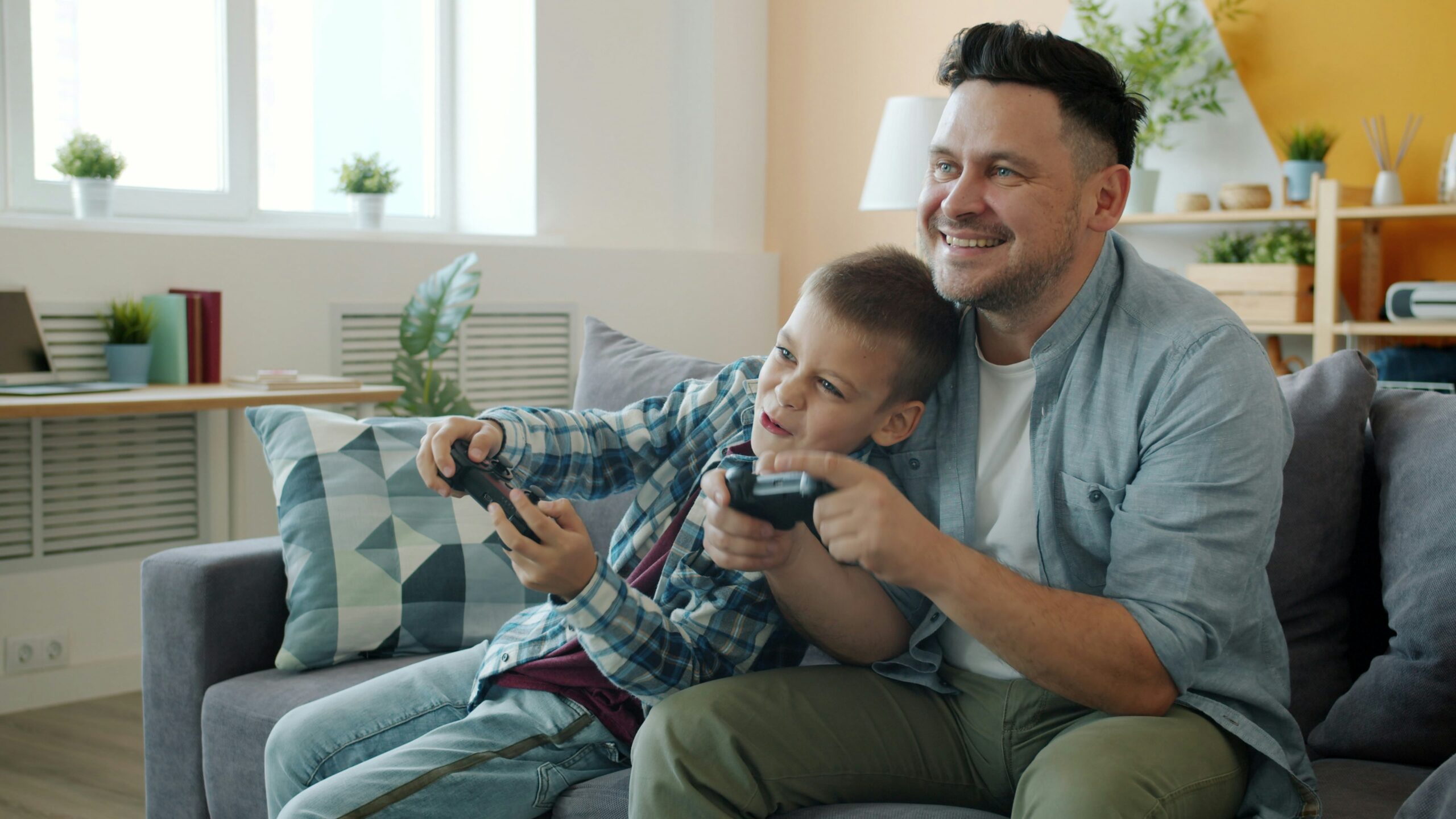
Remember when “family time” meant a board game that ended with someone flipping the Monopoly board? Those days aren’t gone—but they’ve got company. Today, family lifestyle often includes a Nintendo Switch on the coffee table and a heated Mario Kart tournament before dinner. According to a 2023 survey by the Entertainment Software Association, 76% of parents in the U.S. play video games with their kids at least once a week. That’s a staggering shift. Gaming isn’t a solitary escape anymore; it’s become a shared language.
The noise around screen time can be deafening. But here’s the twist: not all screen time is created equal. When a parent sits beside a child, strategizing in Minecraft or laughing at a silly physics glitch, something shifts. It’s no longer about isolation. It becomes a connection. Raw, imperfect, often hilarious connection.
Parenting Tips: Finding the Balance
You want boundaries. They want “five more minutes.” The negotiation is real. One approach that works? Treat gaming like any other family activity—with a clear start and end. Use a visual timer. No, not the one on the phone; a physical one that ticks down. Kids respond to tangibles.
Another tip: play with them first, then set limits. When you understand the game’s appeal, your rules feel less arbitrary. You earn credibility. “I get it, this level is tough—but we agreed on 45 minutes.” That lands differently than a command from across the room.
Also, don’t underestimate the power of co-op games. Titles like It Takes Two or Overcooked force collaboration. You’ll learn a lot about your kid’s problem-solving style—and your own patience under pressure. Can you chop the tomatoes while I wash the dishes? No, the other way! Chaos, yes. But the good kind.
Keep in mind that children’s abilities don’t always meet your expectations. If you’re teaching them homework, suggest a path, give hints, and help them reach their goals independently. When needed, use a math question solver so your child can see examples of solutions and understand the problem. This works well because children can see dozens of solutions and then solve similar problems independently in seconds.
Product Reviews: What Actually Works?
Let’s talk about hardware. The Nintendo Switch remains the undisputed champion of family gaming. Why? It’s portable, it’s resilient, and its library is packed with titles rated E for Everyone. A 2024 review aggregator showed that over 60% of family households with young kids own one. The Joy-Con controllers are small enough for little hands, and the kickstand lets siblings share a screen without squabbling—well, less squabbling.
For headsets, skip the bulky “pro” gear. Look for kid-friendly headphones with volume limiters (85 dB max). Brands like Puro or JLab offer durable, colorful options. One parent I spoke with said her family owns three pairs—and they’ve survived drops, juice spills, and one unfortunate incident involving a hamster.
What about games themselves? Kirby and the Forgotten Land gets consistent rave reviews for its forgiving difficulty and two-player mode. Lego Star Wars: The Skywalker Saga turns a complex universe into a playful co-op adventure. And if you’re seeking educational value? Scribblenauts expands vocabulary through creative problem-solving. A 2022 study found that kids who played it regularly showed a 12% improvement in word association tests.
Kids and Games: The Real-World Impact
Here’s a stat that might surprise you: the American Academy of Pediatrics now acknowledges that high-quality, interactive gaming can enhance cognitive flexibility. Not all games are brain rot. In fact, puzzle games and strategy titles can improve executive function in children aged 8–12.
But—and this is a big but—context matters. A child left alone for hours with a poorly moderated online shooter is a different story than a family playing Animal Crossing together. The latter builds shared narratives. “Remember when we caught that giant fish at 2 a.m.?” becomes a family legend.
Social skills? They can develop too, but only with guidance. Multiplayer games teach negotiation, turn-taking, and handling loss. I’ve seen a 7-year-old console a friend after a lost race with more empathy than some adults manage. “It’s okay, the blue shell was unlucky.” That’s emotional intelligence in action.
Yet challenges exist. Microtransactions are a minefield. One survey found that 39% of parents reported unexpected in-game purchases by their children. Set up password protections. Have conversations about “why the game wants you to buy gems.” It’s not just about money—it’s about teaching digital literacy.
Everyday Family Life: When Screens Unite
Our living room doesn’t look like a catalog. There are snack crumbs between the couch cushions. The dog sometimes howls during suspenseful game moments. And you know what? That’s the texture of everyday family life. Gaming fits into the cracks: a 20-minute session after homework, a lazy Sunday afternoon tournament, a way to unwind when the weather traps everyone indoors.
One routine that stuck in our house is “Friday Night Co-op.” No phones, no distractions. Just us, a game, and a bowl of popcorn that’s gone before the first level ends. It’s predictable, but in the best way. Kids crave rituals. They need anchors. A weekly gaming night becomes a shared reference point—something to look forward to.
Sometimes the game fails. Glitches, frustrating difficulty spikes, or a controller battery dying mid-boss fight. Those moments become the jokes we repeat for months. “Remember when Dad fell off the cliff three times in a row?” Yes, we remember. We laugh. Hard.
Family Activities Beyond the Console
Gaming doesn’t have to end when the console powers off. Extend the experience. After a session of Pokémon, go for a walk and “hunt” for local wildlife. Create a scavenger hunt based on game characters. Use the game as a springboard for drawing, storytelling, or even cooking—there are entire cookbooks dedicated to Zelda recipes.
Physical activity can tie in too. Games like Just Dance or Ring Fit Adventure get bodies moving. One study from the University of Georgia noted that active-play video games can contribute to a child’s daily physical activity by up to 20%. It’s not a replacement for outdoor play, but on rainy days? It’s a lifeline.
Also, consider analog alternatives. Introduce board games that mirror digital favorites. Minecraft: The Board Game or Stardew Valley: The Board Game translate familiar mechanics into tactile, face-to-face experiences. They teach patience, manual dexterity, and the fine art of not eating the game pieces.
Final Thoughts: It’s About Presence
You don’t need to be a “gamer” to engage. You just need to show up. Ask questions. “What’s your favorite part?” “How did you figure that out?” “Can you teach me?” That last one is powerful—it flips the dynamic. Your child becomes the expert. Confidence blooms.
The reality of family lifestyle today includes screens. That’s not a failure; it’s a fact. The goal isn’t to eliminate gaming but to weave it intentionally into the fabric of your days. When done right, it becomes less of a battleground and more of a bridge. A messy, pixelated, wonderfully imperfect bridge.
So grab a controller. Sit on the floor. Let the kid win once—or don’t. The shared experience is the thing that lasts.