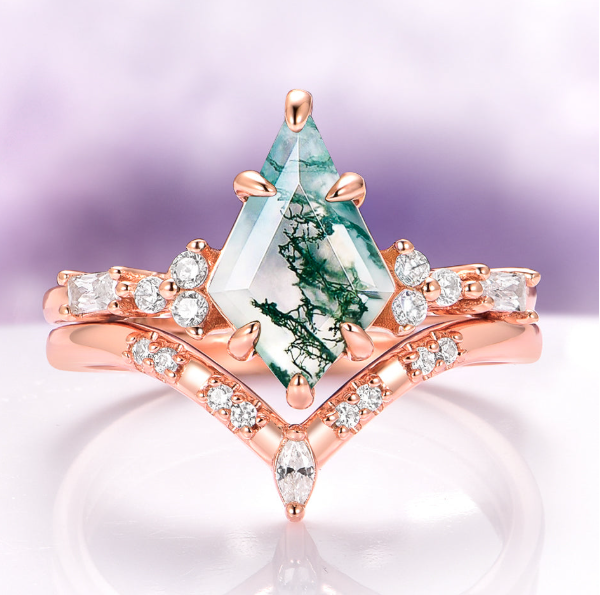
With most gemstones, the cut is an optical decision. Facet angles are calculated to return light, and the outline that results is almost a byproduct. Moss agate does not work that way. It is translucent rather than transparent, so it is usually finished as a cabochon or a flat-faceted slice, and light does not bounce around inside it the way it does in a faceted sapphire. What the cutter is really deciding is composition. A moss agate kite cut engagement ring and an oval version of the same rough can look like two entirely different stones, because the outline is the frame and the dendritic pattern is the picture hanging inside it.
The outline is a frame, not a light engine
Moss agate is a chalcedony, a microcrystalline quartz that carries branching mineral inclusions of iron or manganese oxide. Those dendrites look like ferns or forest canopy, but nothing organic is trapped inside. They grew as mineral formations while the chalcedony was forming, which is why the patterns are irregular, directional, and completely unrepeatable from one stone to the next.
Continue reading “Cut Shapes for Moss Agate: How the Outline Frames the Stone”