
With most gemstones, the cut is an optical decision. Facet angles are calculated to return light, and the outline that results is almost a byproduct. Moss agate does not work that way. It is translucent rather than transparent, so it is usually finished as a cabochon or a flat-faceted slice, and light does not bounce around inside it the way it does in a faceted sapphire. What the cutter is really deciding is composition. A moss agate kite cut engagement ring and an oval version of the same rough can look like two entirely different stones, because the outline is the frame and the dendritic pattern is the picture hanging inside it.
The outline is a frame, not a light engine
Moss agate is a chalcedony, a microcrystalline quartz that carries branching mineral inclusions of iron or manganese oxide. Those dendrites look like ferns or forest canopy, but nothing organic is trapped inside. They grew as mineral formations while the chalcedony was forming, which is why the patterns are irregular, directional, and completely unrepeatable from one stone to the next.
Because the body is translucent and the pattern is fixed in place, the outline does something a faceted stone’s outline never has to do. It crops. Every cut shape is a decision about which part of the internal landscape stays and which part is lost to the wheel, and about what kind of edge that landscape meets when it reaches the border. That single idea explains most of what follows.
How cutters read the rough before committing
Good cutting starts long before anything is shaped. A cutter working with moss agate rough will typically wet the surface or take a thin window slice to see through the skin, because dry rough hides the pattern almost completely. What they are looking for is the depth and direction of the dendrites, whether the moss sits in one plane or drifts through the body at an angle, and where the clear windows are.
Two constraints then compete. The cutter wants the strongest section of pattern centered under the finished face, and they want to keep as much usable material as the rough allows. Those goals rarely point in the same direction, and the outline chosen is usually the compromise that costs the least good pattern. Design overviews from jewelers such as Aquamarise make the same point in reverse: the shape you see in a finished ring is often the shape the stone itself made available.
Geometric outlines: the kite and the hexagon
Kite and hexagon cuts do something specific and slightly confrontational. They place hard, straight, mathematically clean edges around a pattern that is entirely irregular. The result is a deliberate tension between the container and its contents, and it reads as modern rather than soft, even when the stone inside is a gentle mossy green.
The kite has an additional structural effect. Its two long edges converge to a point, which pulls the eye along the length of the stone and creates a sense of direction. When a cutter orients a kite so the dendrites branch upward toward that point, the pattern appears to grow, like a canopy reaching. Oriented the other way, the same stone can look like roots descending. Hexagons behave more neutrally, since their symmetry has no single dominant axis, which makes them the calmer geometric option and a common choice when the internal pattern is already dramatic enough to carry the design alone.
Soft outlines: oval, pear, and the drifting pattern
Curved outlines do the opposite. An oval has no corners for the pattern to collide with, so the moss appears to dissolve softly at the edges rather than being cut off by them. The effect is atmospheric and slightly unfinished in a good way, like looking into a landscape whose borders you cannot see.
The pear sits between the two families. It has the drift of a curve along its body and the direction of a point at one end, so it gives a cutter a way to build motion into a stone without imposing straight edges. Pears reward rough where the pattern is dense at one end and thins toward the other, because the narrowing outline and the thinning moss work together instead of fighting.
Cabochon, flat slice, and the question of depth
Because moss agate does not need facets to perform, two finishes remain fundamental. A cabochon has a domed top, and that dome acts as a lens. It magnifies the pattern slightly, compresses it toward the center, and gives the stone visible depth, so the moss appears to sit at different levels inside a body of material.
A flat-faceted slice does the reverse. It presents the pattern almost like a photograph, evenly and honestly across a level plane, with faceted sides catching light around a still center. Neither finish is better. A cabochon suits rough with layered, three-dimensional dendrites, while a flat cut suits rough where the best pattern lives in one clean plane and would only be distorted by a dome.
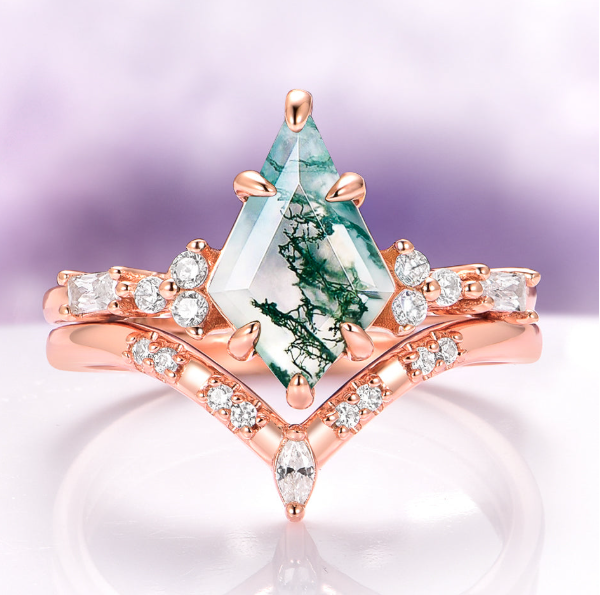
A kite outline gives an irregular dendritic pattern a hard, directional border and a clear visual axis.
Why the same stone reads differently in two outlines
Take one piece of rough with a dense band of dendrites running diagonally through it. Cut as an oval, the diagonal becomes a soft sweep, the eye enters anywhere and wanders, and the stone feels calm and painterly. Cut as a kite with the point aligned to that diagonal, the same band becomes an arrow. The composition now has a beginning and an end, and the stone reads as graphic and intentional.
Nothing about the mineral changed. What changed is the relationship between the pattern’s direction and the outline’s direction, and that relationship is the single most underrated variable in moss agate design. It is also why comparing finished kite cut designs across a curated selection such as the kite cut moss agate engagement rings is more informative than comparing photographs of loose stones. The setting and outline together determine what the pattern is allowed to say.
Orientation, symmetry, and the honest asymmetry of the material
Symmetrical outlines invite an expectation of symmetrical contents, and moss agate almost never delivers that. A perfectly balanced hexagon holding a pattern that is heavy on one side and clear on the other can feel slightly off, not because the cut is poor but because the frame promised something the picture does not provide.
Cutters manage this in a few ways. They may deliberately choose a marquise or a pear so the outline is already directional and the uneven pattern feels intended. They may rotate the stone so the densest moss sits low, where the eye expects visual weight. Or they may accept the imbalance and let the setting correct it, using a fuller gallery or shoulder detail on the lighter side. Knowing this makes it easier to judge a finished ring fairly: an off-center pattern is usually a choice, not a flaw.
Choosing an outline without overthinking it
A few questions settle most of it.
- Does the pattern have an obvious direction? If yes, a kite, marquise, or pear will use it. If not, an oval or hexagon will not fight it.
- Do you want the stone to feel graphic or atmospheric? Straight edges give the first, curves give the second.
- Is the best pattern in one plane or layered through the body? Flat cuts favor the first, cabochons favor the second.
- Would you rather the stone announce itself across a room or reveal itself up close? Geometric outlines carry at distance, soft outlines reward proximity.
A moss agate kite cut engagement ring is not simply a shape preference. It is a decision to put a rigid border around something that grew without rules, and to let the contrast between those two things become the design. Choose the opposite and you get a stone that dissolves gently into its metal instead. Both are legitimate, and the only real mistake is choosing an outline without first looking at which way the moss inside is growing.