
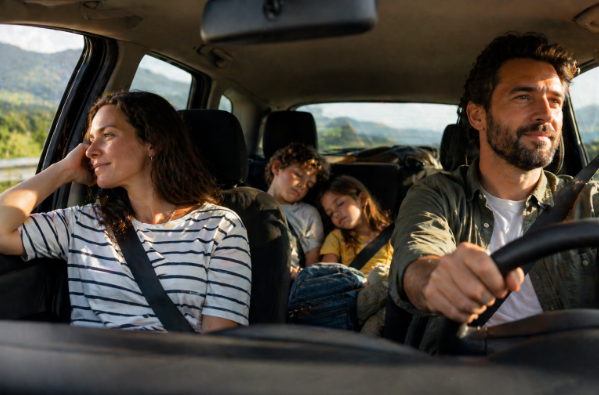
Modern family life often feels like a constant acceleration of schedules. Work, school runs, after-school activities, messages, notifications, and overlapping commitments leave little uninterrupted time in the day. Paradoxically, one of the few environments that still resists this fragmentation is the car.
Driving together does not just move people from place to place. It creates a rare shared pause—time that is structured, enclosed, and temporarily disconnected from external demands. Without consciously trying, families often find that journeys become one of the few moments where life slows down enough to be experienced collectively.
The Car as a Rare Shared Space
Unlike most domestic environments, the family car requires co-presence. Everyone is physically together, facing the same direction, moving through the same space in real time.
Vehicles such as the Honda CR-V or the Skoda Octavia Estate are often chosen because they support this shared experience. They offer enough space for comfort, but still maintain the intimacy of a single environment.
There are no separate rooms, no competing screens in different corners of the house, and no multitasking across different physical spaces. For a short period, everyone is anchored in the same moment.
Why Movement Creates Mental Stillness
It may seem counterintuitive, but motion can create a sense of stillness. When the destination is fixed and the route is determined, the mind often shifts into a lower-effort state.
Driving removes many of the micro-decisions that dominate daily life. There is a clear structure: follow the road, respond to traffic, arrive at a destination. Within that structure, mental space opens up.
This is especially noticeable on longer journeys, where the rhythm of travel becomes predictable. The repetitive sound of tyres on road surfaces, the steady pace of traffic, and the visual flow of passing landscapes all contribute to a subdued cognitive environment.
Conversations That Don’t Happen Anywhere Else
One of the most understated effects of shared driving time is the quality of conversation it enables.
In homes, conversations are often interrupted by devices, tasks, or competing priorities. In contrast, the car creates a contained environment where attention is naturally aligned.
Children may talk more freely when they are not being directly observed in a structured setting. Adults may discuss practical matters without the pressure of formal conversation. Even silence feels more comfortable because it is shared rather than isolated.
These are not necessarily deep or planned conversations—they are often incidental. But their timing and setting make them more memorable.
The Rhythm of Routine Journeys
Family driving is rarely random. Most journeys are built around repetition: school runs, work commutes, weekly shopping trips, and regular visits to familiar places.
Over time, these repeated routes create a rhythm that structures part of family life. The same roads, the same turning points, the same traffic patterns—these become familiar markers of time passing.
In vehicles like the Toyota Corolla Touring Sports, this repetition becomes part of the ownership experience itself. The car is not just transporting people; it is accompanying them through cycles of daily and weekly life.
Reduced Distraction, Not Forced Connection
Unlike many shared family environments, the car does not require interaction. There is no expectation of constant conversation or activity. Instead, connection happens organically.
Some passengers listen to music, others look out of the window, and some simply rest in silence. This coexistence without obligation is part of what makes the space feel calm.
It is a rare example of shared presence without enforced engagement.
The Psychological Effect of Enclosed Movement
Being inside a moving vehicle creates a unique psychological condition. The external world is in motion, but the internal environment remains stable.
This contrast can have a calming effect. The brain registers progress without requiring active decision-making. Time feels structured, even when no specific activity is taking place.
In a broader sense, the car becomes a transitional space between obligations. It is neither home nor destination, but something in between that temporarily suspends both roles.
Technology’s Subtle Role in Calmness
Modern vehicles increasingly contribute to this sense of ease through technology. Navigation systems reduce uncertainty, driver assistance features reduce cognitive load, and climate control systems maintain consistent comfort.
In newer models such as the Kia Sportage, these systems work quietly in the background, allowing occupants to focus less on logistics and more on simply being in transit.
Even entertainment systems, when used passively, contribute to a shared atmosphere rather than dividing attention.
The Car as a Neutral Emotional Space
Homes often carry emotional weight—rooms are associated with tasks, responsibilities, or personal routines. The car, by contrast, tends to function as a neutral space.
It is not tied to any single role or expectation. This neutrality allows different moods to coexist more easily. A tired morning commute and an excited weekend journey can take place in the same environment without conflict.
This flexibility is part of why families often use driving time to reset between activities.
Small Details That Reinforce Familiarity
Over time, families develop subtle habits within their vehicles—preferred seating positions, familiar storage arrangements, or recurring playlists. These details may seem minor, but they reinforce a sense of consistency.
Even external elements of vehicle identity contribute to this familiarity. For drivers investing in personalisation, companies like Number 1 Plates have seen interest from motorists who want their vehicles to reflect a more considered and individual identity, aligning with the broader trend of making everyday environments feel more personal and grounded.
These touches do not change the function of the car, but they contribute to how it is experienced over time.
Why Slowing Down Happens Without Intention
What makes driving together unique is that the slowing down effect is not designed. It is incidental.
Families do not enter the car intending to slow their pace. Yet the structure of the environment naturally encourages it. There are limited distractions, a defined route, and a shared physical space that resists fragmentation.
In a daily life increasingly shaped by speed and interruption, this unplanned pause becomes more valuable precisely because it is not manufactured.
Conclusion
Driving together offers something that is increasingly rare in modern life: uninterrupted shared time without pressure or expectation.
Within the enclosed environment of a car, families experience a natural slowing down that emerges from structure rather than intention. Conversations unfold differently, silence feels comfortable, and attention becomes shared rather than divided.
It is not the journey itself that creates this effect, but the conditions around it—movement, containment, and continuity.
In that space, families do not need to slow down deliberately. They simply do.