
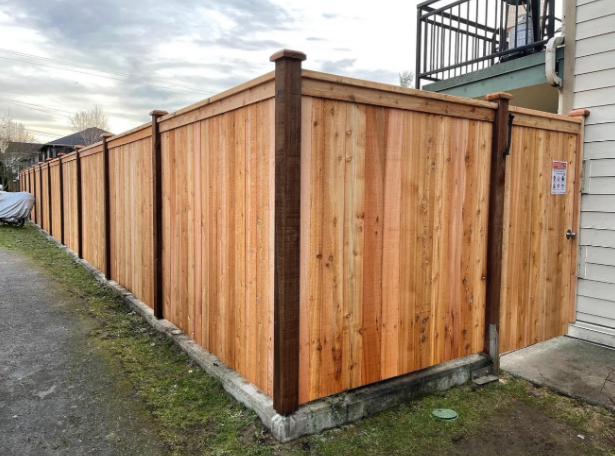
Most Bellevue homeowners don’t think about their fence until something goes wrong. A board splits. A post leans. A panel gets hit by a fallen branch during one of the Eastside’s winter windstorms. And then the question becomes: fix it or replace it?
Fence repair in Bellevue, WA is a genuine judgment call that depends on several factors — the age of the fence, the material, the extent of the damage, and what the underlying condition of the structure looks like once a professional actually inspects it. The answer isn’t always obvious from the outside. A fence that looks like it needs one board replaced sometimes reveals deeper structural problems once the repair work opens it up. A fence that looks ready for replacement sometimes only needs targeted repair to get another decade of life.
What PNW Conditions Do to Bellevue Fences Over Time
The Moisture Accumulation Problem
Bellevue’s climate doesn’t create sudden fence failures most of the time. It creates gradual degradation that builds invisibly over multiple wet seasons. Moisture infiltrates past failed caulk joints, pools at post bases in saturated soil, and keeps wood in the 19-20% moisture content range where rot fungi establish and spread. The damage accumulates quietly for years.
This is why fence problems in Kirkland, Redmond, and Sammamish neighborhoods tend to surface as multi-point failures — a leaning post here, a rotted board there, soft rails throughout — rather than isolated damage. The fence was failing systemically while it still looked presentable from a distance.
Storm Damage as a Discovery Event
Winter windstorms in the Bellevue area — particularly Pineapple Express events that bring sustained high winds — cause visible fence damage that prompts repair calls. A fallen panel, a broken post at grade, boards stripped from a section of fence. The storm damage is real, but the storm often just finished what years of moisture damage had started. The post that snapped in the wind was already compromised by rot at the base.
This matters for repair decisions: visible storm damage on a fence with years of moisture exposure may be better treated as the trigger for a broader assessment rather than just a point repair.
The Repair vs. Replace Decision Framework
Fence Age and Original Construction Quality
A 5-year-old cedar fence with a damaged post is an easy repair call — the fence has most of its service life ahead and the structural condition is likely sound. A 20-year-old cedar fence with a damaged post is a different calculation. Even if the visible damage is limited, the overall fence may have accumulated enough moisture damage that repair buys only a few additional years.
The age and original quality of construction both factor into this. A fence built with ground-contact pressure-treated posts, quality cedar boards, and proper flashing details may still be fundamentally sound at 15 years. A fence built with untreated posts, standard lumber, and no post caps may be structurally compromised at 10 years in Bellevue’s climate.
The Probe Test: What a Professional Actually Does
The right starting point for any Bellevue fence repair decision is a physical inspection that includes probing structural members. Pressing a screwdriver firmly into posts, rails, and boards tells more than visual inspection does. Sound wood resists the tool. Rotted wood allows penetration with light pressure.
Post condition is the most important variable. Fence posts in Bellevue that have rotted at the base — at grade or below — can’t be repaired. They require full replacement. A fence where multiple posts are soft is a fence that’s approaching end-of-life regardless of what the boards look like. Post rot is structural; board rot is cosmetic.
The 30% Rule
A useful rule of thumb: if repair work would address less than 30% of the fence’s total linear footage, repair is likely cost-effective. If repair reaches 30-50% or more of the fence, replacement usually delivers better value — you get a new fence and a fresh warranty rather than a patchwork structure of old and new materials aging at different rates.
What Fence Repair in Bellevue Typically Involves
Post Replacement
Post replacement is the most structurally significant repair type. The affected section of fence needs to be detached, the old post excavated, a new ground-contact pressure-treated post set in concrete, and the section reinstalled. In Bellevue neighborhoods with rocky or root-compacted soil — particularly in Bridle Trails and Cougar Mountain — post excavation can be more involved than it sounds.
Replacing posts one at a time while leaving other aging posts in place produces a fence with mixed structural condition. In many Bellevue fence repair projects, adjacent posts that aren’t visibly failing benefit from probing before the decision to leave them is made.
Board and Rail Replacement
Individual board replacement — matching species, profile, and height to existing fence boards — is the most common repair task. Cedar boards are generally available in the sizes and profiles needed to match existing fencing. Boards that have rotted at the base should be replaced with boards sealed on all six sides before installation to slow moisture infiltration.
Rail replacement follows the same principle. Horizontal rails that have rotted at their top face — the horizontal surface that holds water in Bellevue’s climate — need full replacement. Sistering a new rail to a rotted one produces a structure where the rotted material is still present and continues to harbor moisture.
Optima Fence and Deck handles fence repair in Bellevue and throughout the Eastside — Kirkland, Redmond, Sammamish — with inspection-first assessments that give homeowners accurate information about what their fence actually needs before committing to a scope.
Frequently Asked Questions
How do I know if my Bellevue fence needs repair or full replacement?
The best indicator is a physical inspection — probing posts, rails, and boards with a screwdriver. Sound wood resists firmly; rotted wood allows easy penetration. If multiple posts are soft at the base, replacement is usually more economical than repair. If damage is isolated to one section with sound structure elsewhere, targeted repair makes sense. A professional inspection gives you the accurate picture.
What’s the most common fence repair needed in Bellevue, WA?
Post replacement due to base rot is the most structurally significant repair common in Bellevue and Kirkland. Cedar post bases in contact with Bellevue’s wet soil reliably rot within 10-15 years without ground-contact pressure treatment. Board and rail rot from surface moisture infiltration is the most frequently visible repair, though it’s cosmetic rather than structural.
Can a leaning fence post be repaired without replacement?
A post that’s leaning because the concrete footing has shifted or because surrounding soil has eroded can sometimes be releveled by adding concrete around the base. A post that’s leaning because it’s rotted at or below grade cannot — the rot has compromised the structural member and repair materials applied to rotted wood have no long-term durability. The probe test determines which situation you’re in.
How long does fence repair take in Bellevue?
Small repairs — one to three posts or a section of boards — typically take one day. Larger repair projects spanning significant fence runs may take two to three days. Emergency repairs after storm damage can often be scheduled within a week during spring storm season when demand is high in Bellevue and Redmond.
Does fence repair require a permit in Bellevue, WA?
Repair work — replacing like-for-like posts, boards, and rails — generally doesn’t require a permit in Bellevue. Work that changes the fence height, location relative to property lines, or involves structural changes to an attached structure may require permit review. If you’re uncertain, a quick call to the City of Bellevue permitting department clarifies whether your specific scope needs review.