
Ask most people where their heart is located and they will point to the left side of their chest, further out than it sits. The question comes up at odd moments, such as a twinge while you are carrying the shopping or lying awake at night.
Most people asking it want to know one thing: whether a pain on the left side of their chest could be their heart. Knowing where the heart sits helps, but position alone cannot tell you whether chest pain is coming from your heart, because your chest muscles, ribs, lungs and food pipe are all close by too. If the pain keeps coming back, consider seeing a heart specialist to find the underlying cause.
In this article, we will cover where the heart is located in the body, whether it can be on the right side, whether its position differs in women, and how to tell if chest pain is heart related.
Where Is the Heart Located in the Body?
The heart is located in the centre of your chest, between your two lungs and behind your breastbone (sternum). More of it lies to the left of the breastbone than to the right, so your heart is on the left side, but only slightly. It reaches from about the level of your second rib down to your sixth and rests on the diaphragm, the dome-shaped muscle that separates your chest from your stomach area.
An adult heart is roughly the size of a fist and weighs about 280 grams (10 ounces) on average. Its main job is to pump blood around your body. Your rib cage protects it, and a thin sac called the pericardium covers it.
Because the heart is tilted, its lower tip points down and to the left, into the gap between your fifth and sixth ribs, roughly in line with the middle of your collarbone. That is why your heartbeat usually feels strongest there, and why so many people think of the heart as sitting on the left.
If you want to find it, rest your hand flat on the centre of your chest and move it down and slightly to the left. The beat is often easier to feel when you lie on your left side, because the heart moves closer to the chest wall.
Can Your Heart Be on the Right Side?
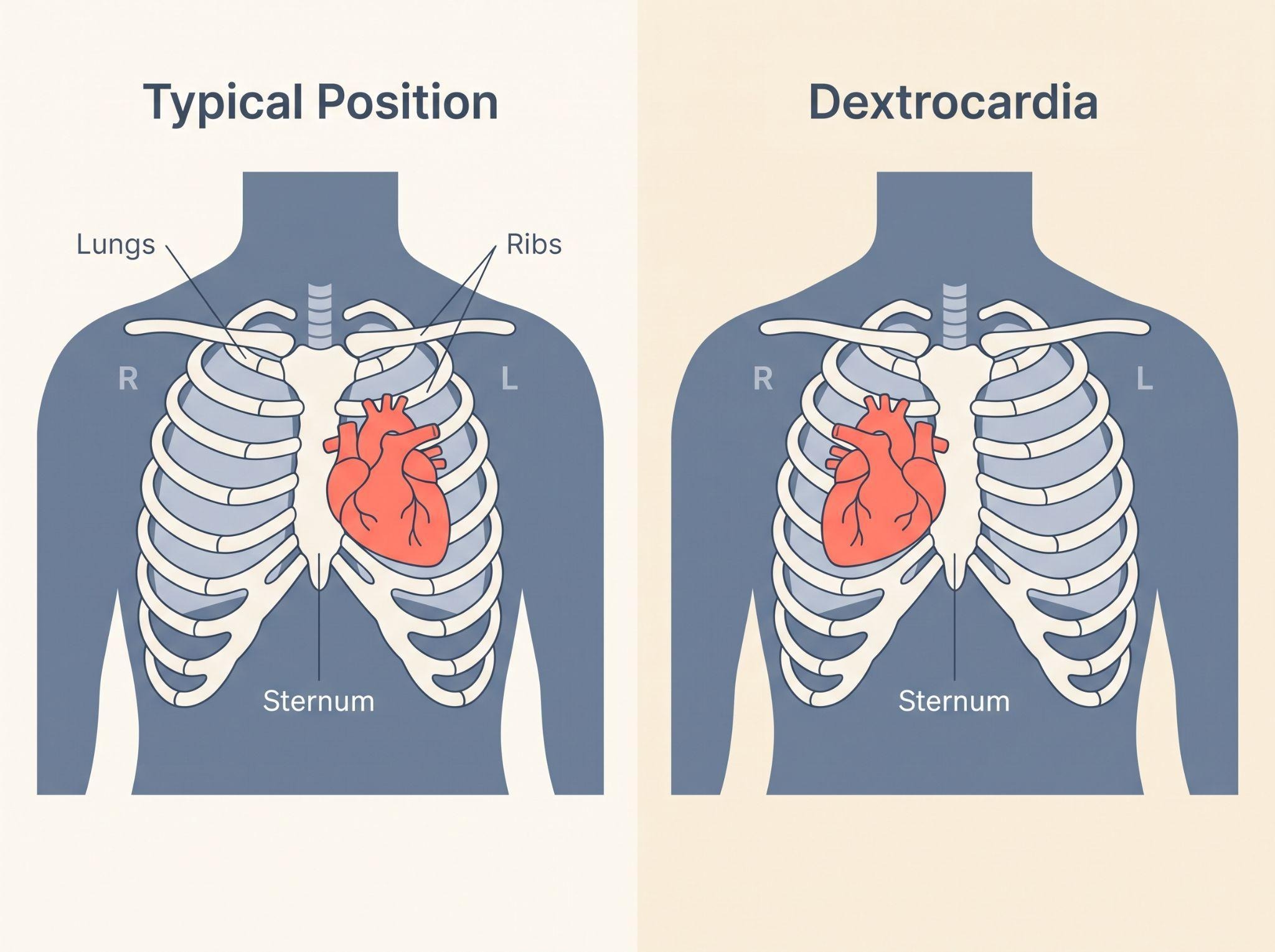
Your heart can be on the right side of your chest, but this is rare. The condition is called dextrocardia, and it occurs in about 1 in 12,000 pregnancies. In some people, only the heart is reversed. In others, the organs in the chest and abdomen are a mirror image of the usual layout, with the liver on the left instead of the right. That is a condition called situs inversus.
On its own, dextrocardia does not usually cause symptoms. So many people only find out by chance, during a chest X-ray or a heart test done for another reason. When dextrocardia comes with no other heart problems, most people live normal, healthy lives. But many people with dextrocardia are also born with other heart conditions, and those may need treatment.
Is a Woman’s Heart Located Differently From a Man’s?
No, a woman’s heart is located in the same place as a man’s. The heart lies inside the rib cage and the breast tissue lies outside it, so breast size and shape do not change where the heart is. The heart is also closer to the middle of the chest than the left breast is.
Heart size varies with body size and sex, and women’s hearts tend to be slightly smaller than men’s. Heart attack symptoms can differ too. Women are more likely than men to have symptoms other than chest pain during a heart attack, such as breathlessness, nausea or pain in the back or jaw. That means a woman may not suspect a heart problem at first, so it helps to know the other warning signs as well as chest pain.
How Do You Know if Chest Pain Is Heart Related?
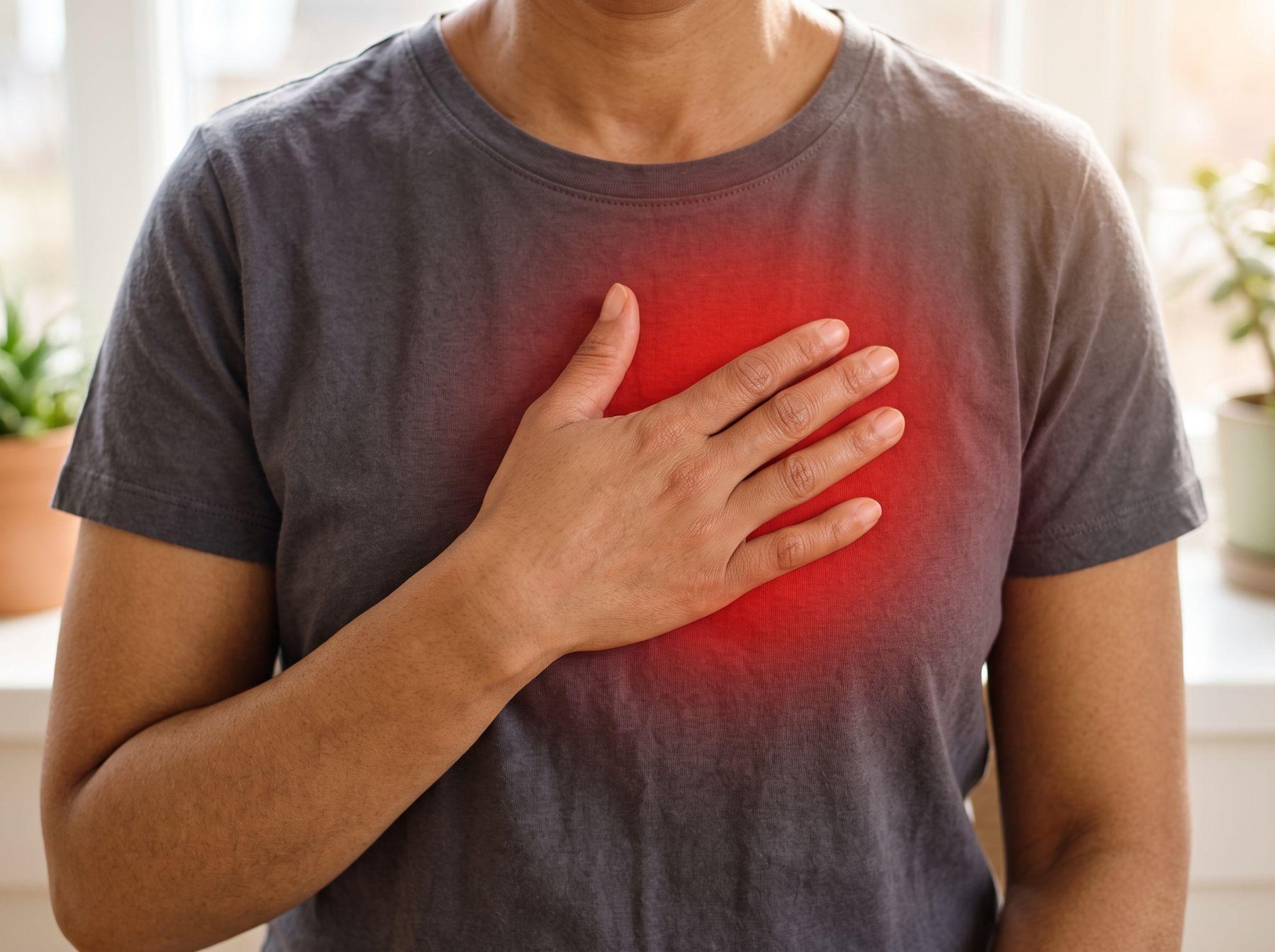
Chest pain is more likely to be heart related when it feels like pressure, squeezing or tightness inside your chest. It may also spread to your arm, neck, jaw, stomach or back, or come with sweating, feeling sick, light-headedness or breathlessness. Pain that starts when you are active or stressed and eases within a few minutes of rest can also be angina, where the heart is not getting enough blood.
In fact, the location of the pain is a less reliable guide than how it feels, because heart pain is often felt in the centre of the chest, not only on the left. Chest pain that comes on suddenly and does not go away, or that comes with any of the symptoms above, needs emergency medical care straight away.
Many other causes of chest pain are more common, and each has a pattern of its own:
- Muscle strain – tends to follow exercise or an injury. Resting the muscle usually eases it.
- Indigestion – starts after eating, often with bloating, a feeling of fullness or a bitter taste in your mouth.
- Anxiety – can cause a sharp, continuous pain during stress or worry, with a fast heartbeat, sweating or dizziness.
- Chest infection – hurts more when you breathe in, and comes with a cough, yellow or green mucus or a high temperature.
Chest pain that comes and goes should still be medically assessed, even when it seems to fit one of these patterns.
The Bottom Line: Knowing Your Heart Brings Peace of Mind
Your heart is in the middle of your chest, tilted slightly to the left, and it is in much the same place in men and women. Knowing that helps you describe what you feel, but it cannot rule a heart problem in or out, so chest pain that keeps returning is worth having checked.
For most people, a clearer picture of where the heart sits and how it works brings reassurance. It also makes it easier to take good care of your heart for many years to come.