
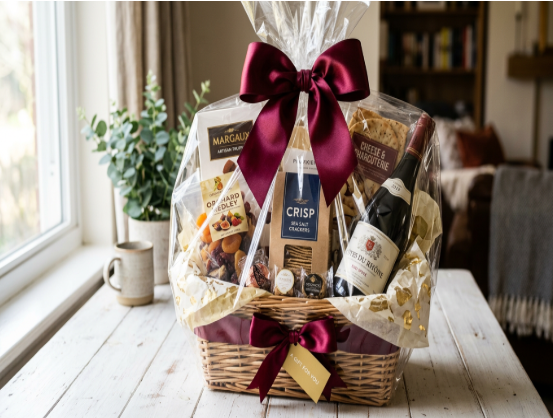
We’ve all been there. Standing in the middle of a shop, staring blankly at shelves, trying to figure out what on earth to buy someone who already has everything — or someone you barely know well enough to guess their taste. Flowers feel impersonal. Vouchers feel lazy. A random scented candle? A gamble.
That’s exactly where a well-chosen gift basket earns its place. It’s layered, it’s thoughtful, and it says a lot about how well you know someone — even when you’re pulling it together under time pressure. It’s no surprise that popular gift baskets have become one of the most searched gifting options year-round.
According to Business Research Insights, the global gift basket market was valued at USD 10.6 billion in 2025, projected to hit USD 19 billion by 2035. That kind of growth doesn’t happen unless people keep coming back to the format — and they do, because it works.
The Psychology of Giving: Why a Good Gift Feels So Good
Before we get into occasions and logistics, it’s worth asking why gifts matter so much to us in the first place. The answer turns out to be deeply biological.
Research from the University of Arizona shows that both giving and receiving gifts activate the brain’s reward systems, releasing dopamine and oxytocin — the chemicals associated with pleasure, trust, and emotional connection. The “warm glow of giving” isn’t just a nice phrase; it has measurable well-being benefits for the person doing the giving, not just the one receiving.
What this tells us is that the value of a gift isn’t really about money. It’s about the signal. A well-curated gift says: I paid attention. I thought about you specifically. That’s why generic, last-minute presents land flat even when they’re expensive — and why a carefully chosen basket of someone’s favourite things can feel genuinely moving.
A January 2026 piece in Psychology Today reinforces this: the gifts people treasure most are the ones that reflect the giver’s knowledge of them. Gift baskets, when done well, do exactly that. They’re a collection of small, considered choices that together say something whole. The same principle applies whether you’re choosing the perfect Christmas present or putting together something for a friend’s birthday.
A notable statistic: 65% of consumers now prefer customised or themed gift baskets over generic alternatives. The market has caught up with what the psychology has always known — personalisation is the point.
A Gift Basket for Every Occasion
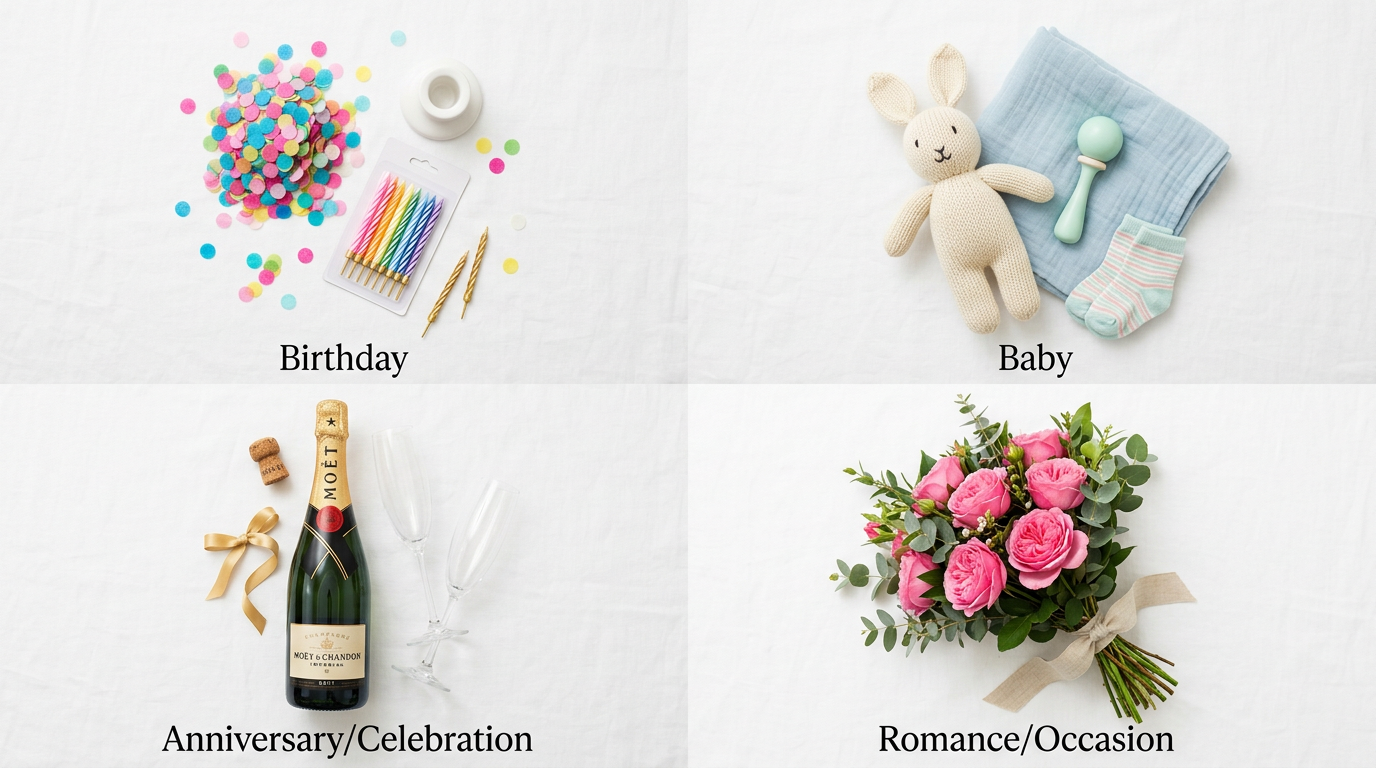
Flat-lay of occasion-themed items with birthday candles, baby items, wine, and flowers
The enduring appeal of popular gift baskets lies in their versatility. They adjust effortlessly to the moment, which makes them suitable for many occasions.
Birthdays
Birthdays account for roughly 40% of the entire gift basket market — and it’s easy to see why. They’re the occasions where you most want to feel celebrated, not just acknowledged. A birthday basket lets you layer meaning into a single gift: a bottle of their favourite wine, a box of the biscuits they always have at home, a little something that references an in-joke or a shared memory. For milestone birthdays — the 40s, the 50s — you can build a “things I love about you” concept around specific, personalised items. It takes more thought than a card, but the result lands completely differently.
New Baby and New Parents
This one has two entirely different briefs, depending on who you’re gifting to. A baby-focused basket — soft toys, muslins, baby toiletries — is lovely, but a parent-focused basket is often the more welcome surprise. New parents are exhausted, their social lives are temporarily on hold, and nobody has thought to give them anything for themselves. A basket built around good coffee, fancy biscuits, a bath bomb, and a magazine or small book hits differently when the recipient hasn’t had ten minutes to themselves in a fortnight. Practical beats decorative here every time.
Christmas and the Festive Season
The hamper is the spiritual home of Christmas gifting in the UK. Gourmet food, wine, cheese, biscuits, a jar of something pickled — there’s a reason the format has endured for over a century. We recently tried a gourmet British deli hamper, and it was a reminder of how good a well-assembled food basket can be when the quality is genuinely there. Worth noting: there’s been over 37% growth in organic, artisan, and eco-friendly gift baskets in recent years — if your recipient is sustainability-conscious, that’s now genuinely well-catered territory.
Get Well Soon
The brief here is simple: comfort and ease. Teas, a good soup, something soft to eat that requires no effort, maybe a light read or a puzzle. Avoid anything that requires assembly, decision-making, or refrigeration. A poor person lying on the sofa doesn’t want to figure out what to do with a raw ingredient box. They want to feel cared for, not given homework. The emotional power of a get-well basket is that it arrives when the recipient can’t socialise — it’s a physical reminder that they’re being thought of.
Thank You and Just Because
This is the most underrated occasion in gifting. A “thank you” basket — or a “just because” one — carries no expectations and no occasion pressure. It’s pure appreciation. And because there’s no deadline or social obligation attached, it often lands more warmly than something sent for a birthday. This is where personalisation really shines: match the basket to their personality (a coffee lover, a spa obsessive, a bookworm), and you’re telling them something about how you see them. Some services even offer the option of letting the recipient choose their own treats — which works brilliantly for people whose tastes you’re less certain of.
How to Choose the Right Gift Basket
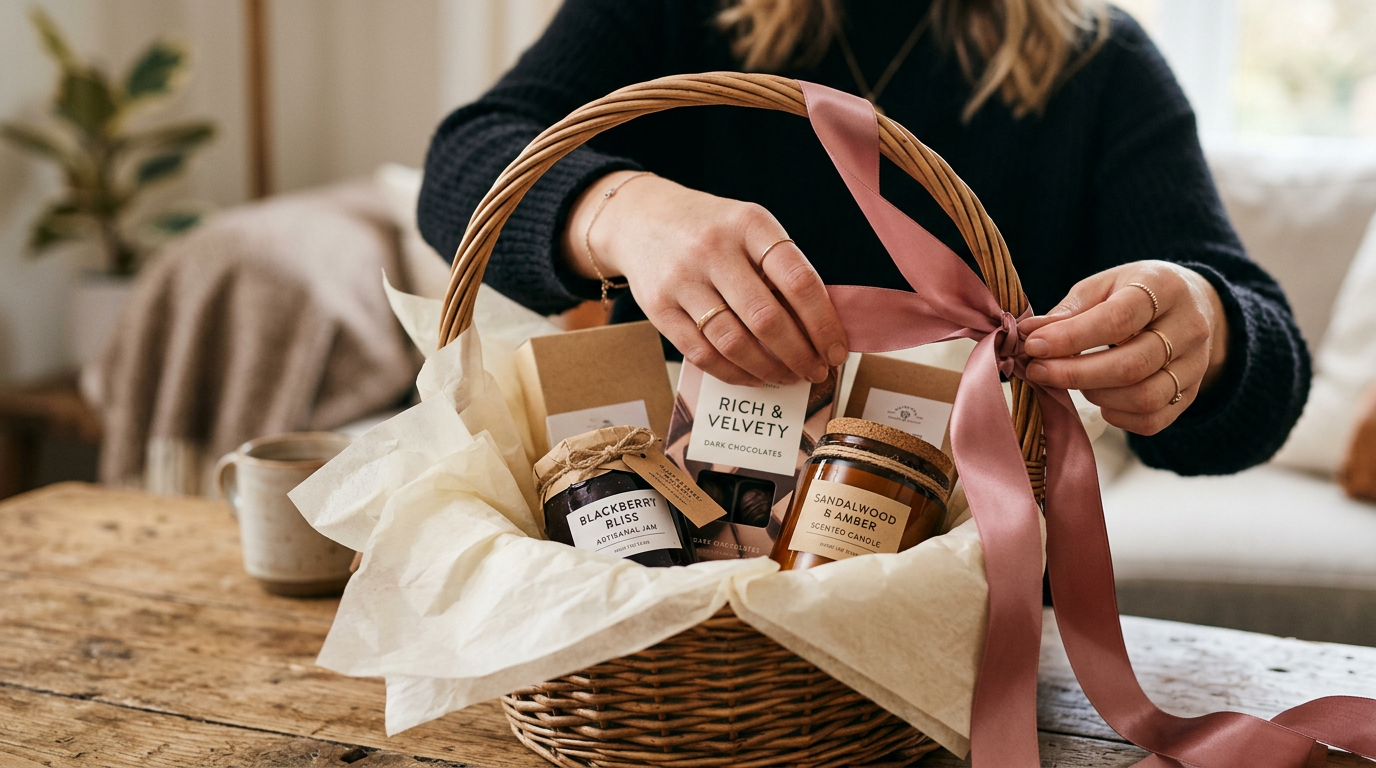
Close-up of hands wrapping a gift basket with tissue paper and ribbons
The difference between a gift basket that gets tucked into a drawer and one that gets talked about comes down to a few practical decisions.
- Know your audience first. Dietary needs, allergies, and lifestyle choices matter here more than in most gifts. A basket full of wine and cheese is wasted on someone who doesn’t drink. A hamper of meat products misses the mark for a vegetarian. It sounds obvious, but it’s the most common way gift baskets fall flat.
- Match size to occasion. A small, considered “thinking of you” basket is a different beast from a full celebration hamper. Overspending on a casual thank-you can feel awkward; underdoing a major milestone reads as indifferent. As a rough guide: £40–60 for lighter occasions, £100+ for significant milestones or corporate gifting.
- Prioritise quality over quantity. This is the hill worth dying on. A basket stuffed with fillers — cheap chocolates, promotional samples, items that feel like leftovers — undermines the whole effort. Research consistently shows that 3 in 5 Brits receive unwanted gifts at Christmas, with £1.27 billion spent annually on things that go unappreciated. A tightly curated basket of genuinely good items will always beat a large basket of mediocre ones.
- Personalise where you can. Even a single added touch — a handwritten note, one item you know they love specifically — transforms a basket from “nice” to “memorable.” It’s the difference between a product and a gift.
- Think about the container. A reusable basket, a decorative tin, a quality box — these become part of the gift rather than packaging to be discarded. It extends the value and the memory of the gesture.
A 2025 study from the University of Illinois Gies Business School introduced the concept of “mindful gifting” — choosing gifts based on thoughtfulness, sustainability, and genuine empathy rather than price. Gift baskets, when assembled with care, are almost a textbook example of the approach.
Ready-Made or DIY: Which Is Right for You?
Both approaches have genuine merit — and the right choice depends on your situation, not a value judgement.
- Ready-made baskets work best when you’re short on time, gifting someone you don’t know intimately (a colleague, a client, a friend-of-a-friend), or want the reassurance of professional curation and presentation. Quality services take the guesswork out of pairing and ensure everything arrives looking good. For corporate gifting in particular, this is usually the more practical and reliable route.
- DIY baskets work best when you know the person well enough to really lean into their specific tastes. You control the budget, the theme, the mix of items — and the result can feel extraordinarily personal in a way that pre-made options rarely achieve. The tradeoff is time and effort, but for the right person and the right occasion, it’s absolutely worth it.
Honestly? Neither is better. It depends on how well you know the recipient, how much time you have, and what the occasion calls for. Some of our favourite gifts have been beautifully assembled, ready-made hampers; others have been cardboard boxes we filled ourselves with an assortment of things someone loved. The thought is the constant.
Give Something They’ll Actually Love

A smiling person receiving a beautifully wrapped gift basket
The best gift is the one that makes the recipient feel seen — and that’s a harder bar to clear than most people admit. A gift basket, done thoughtfully, clears it almost by design. It’s flexible enough to work for virtually any occasion, personal enough to communicate real effort, and generous enough to feel celebratory even when the occasion is small.
Whether you’re assembling something yourself or choosing from a curated service, the same principle applies: think about the person, not the price tag. Think about what they’d pick for themselves if they had an afternoon to browse. Think about what they’d open and smile at.
That’s what a good gift does. And a well-chosen basket does it better than almost anything else.